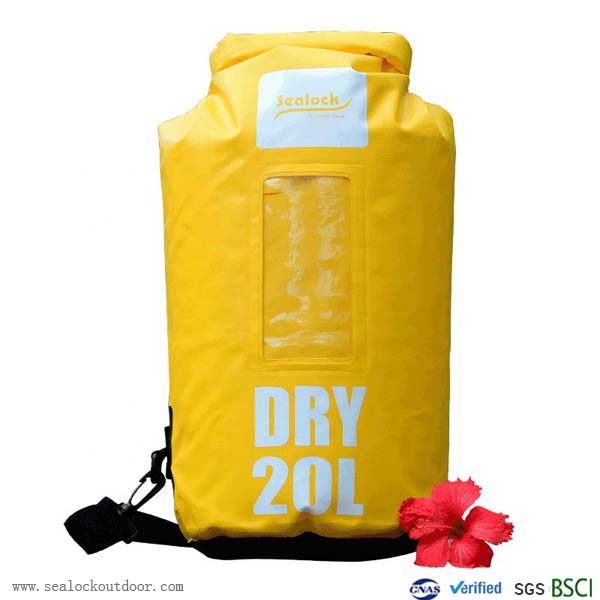
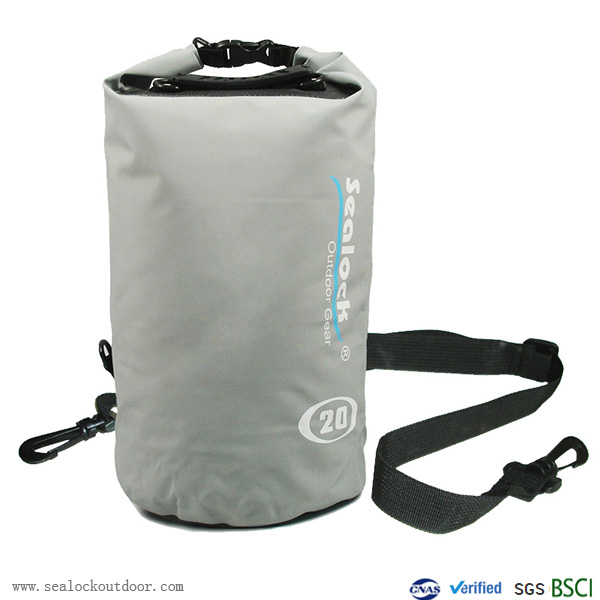
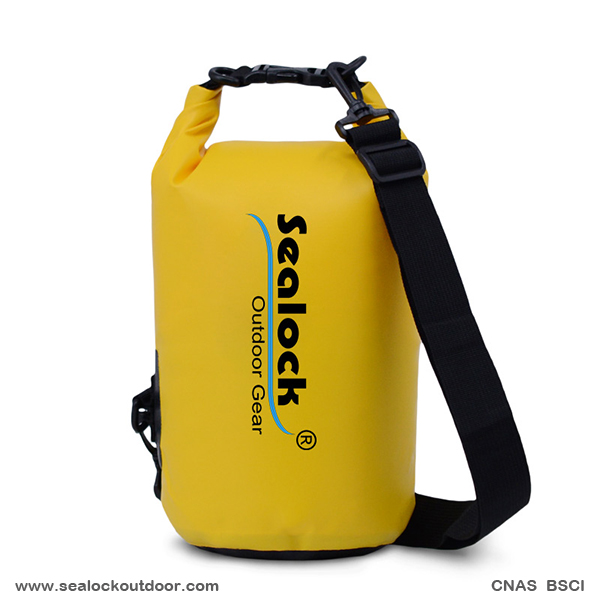
Sealock is a dry bag manufacturer and OEM supplier. Choosing a supplier for this category is deceptively risky, because the product looks simple and the sample almost always passes. A dry bag is a welded tube with a roll-top — any supplier can source something that appears waterproof, and far fewer can build something that genuinely stays waterproof across ten thousand units and two seasons of use. This guide sets out how experienced buyers vet a dry bag supplier, in the order they check it.
Step One: Establish Whether You're Talking to a Factory
The single most useful filter, and it usually resolves within one email exchange. A real dry bag factory can:
Name its welding equipment and frequency — high-frequency welding at 27.12 MHz, bar-electrode or rotary machines, and how many lines run in parallel.
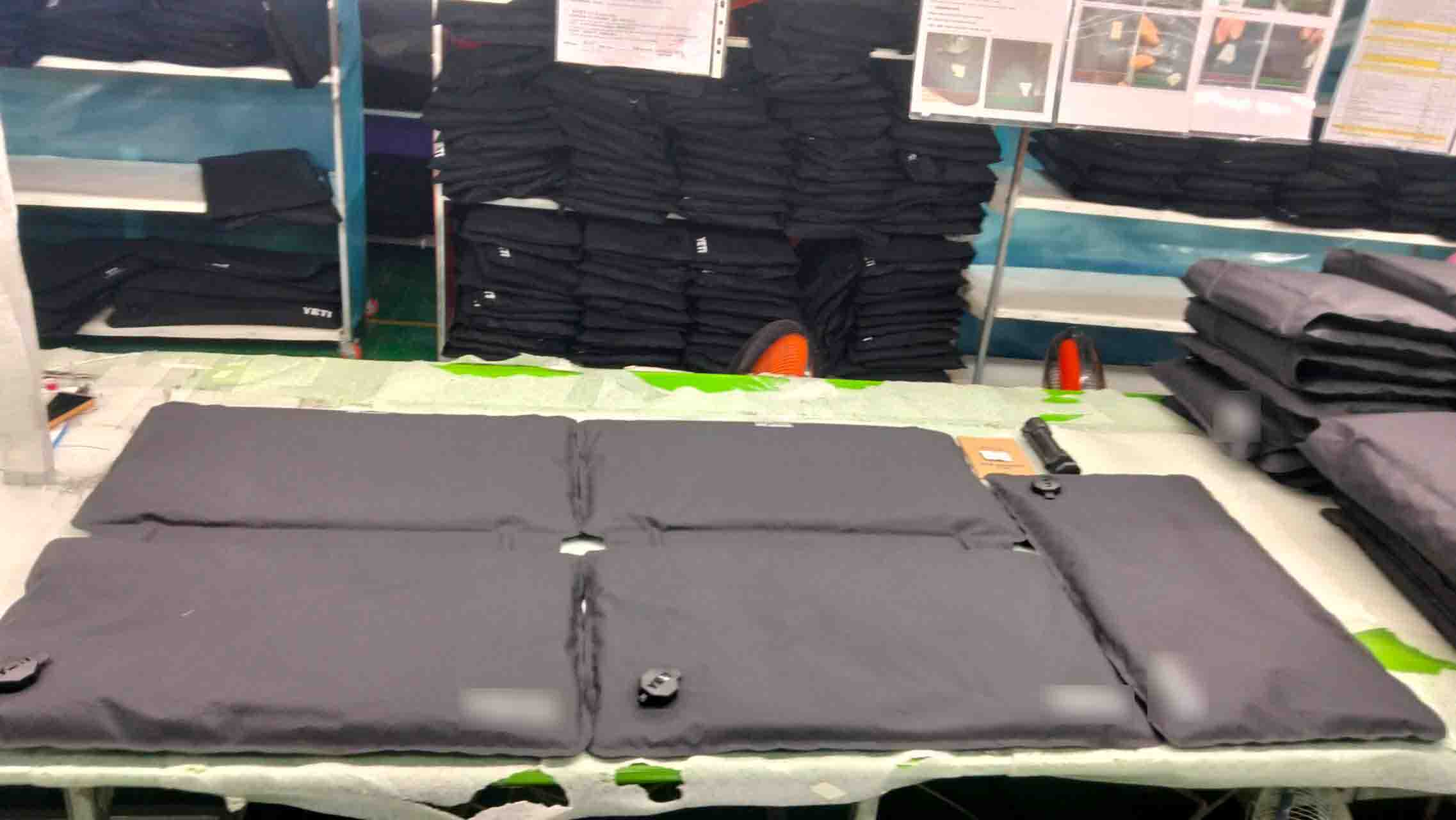
Show the production line — video or a live walkthrough, not catalogue photography.
Provide close-ups of welded seams, corners and attachment points on request.
Answer process questions in depth — weld width, cooling time, die tooling, how load points are attached.
A trading office subcontracts production and cannot go deep on process. There's a second, subtler test: ask the supplier to critique your design. A factory with its own pattern room will flag a structural weak point, suggest a weld-friendlier radius, or propose a stronger anchor layout. A supplier that can only copy your reference photo — and never pushes back — is almost always reselling someone else's production.
This matters more here than in most categories because a capable dry bag factory owns its welding process. A supplier that outsources welding cannot guarantee weld consistency batch to batch, and the weld is the entire product.
Ask about the process, not the price — the answers separate factories from offices within one exchange.
Step Two: Verify the Welding Capability Specifically
High-frequency welding fuses the panels into an airtight seam with no needle holes. Stitched-and-taped seams leak once the tape lifts, sometimes within days of real immersion. So the questions to ask are narrow and technical:
Is welding done in-house, or subcontracted?
What weld width is used, and how is it verified?
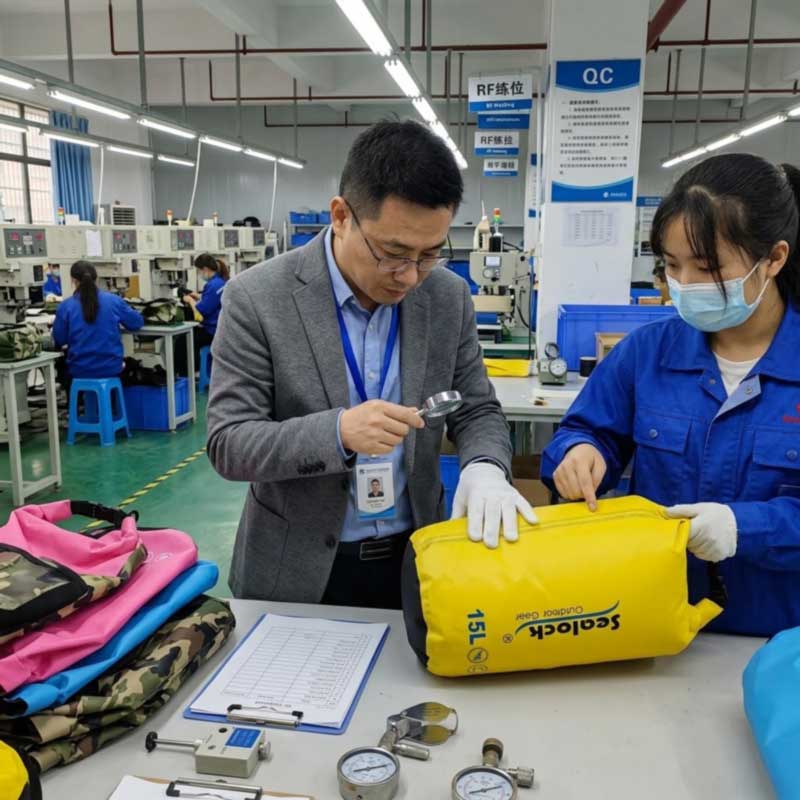
Are peel tests run on sample welds at the start of each production run? This is the check that catches a cold weld — a seam that looks finished and delaminates weeks later.
How are weld parameters documented and controlled across shifts?
That last question is not academic. A documented case in this category: a kayak rental company ordered 2,000 dry bags from a supplier advertising "military-grade waterproofing." Within two months, 17% came back with failed seams near the base — traced to inconsistent RF welding temperature settings during night shifts. The buyer had skipped closure testing data and any post-delivery support agreement. After renegotiating terms to include mandatory weld log audits, subsequent shipments reached a 99.6% seam integrity rate. Parameter discipline across shifts is a real variable, and it's worth asking about explicitly.
Step Three: Get the Test Standard in Numbers
Ask for the standard as a figure with a verification method, never the word "waterproof." Points to pin down:
Which IPX level, and on what basis. IPX7 is a defined test — 1 metre for 30 minutes. IPX8 is continuous immersion beyond 1 metre to a depth the manufacturer declares, so an IPX8 claim with no stated depth cannot be verified.
Whether the rating is proven on the finished bag or inferred from a fabric specification. A compliant fabric does not certify an assembled bag.
Which physical leak tests are run — real water submersion, air-inflation bubble testing, negative-pressure leak determination.
Whether tests run on production samples or on production units. A perfect pre-production sample proves the design; units drawn from the actual run prove the batch.
Whether you can see inspection photographs and records. Evidence, not assurance.
Be wary of the opposite failure too: a supplier that overclaims a depth rating it cannot demonstrate is telling you something about how it will handle every other specification.
Step Four: Check the Certificates Properly
Certificates are easy to produce and easy to misread. When reviewing one, check the issue date, the company name, the certificate holder, the issuing body, the product category, and the report number — and confirm it actually applies to the product you are buying. An expired certificate, a certificate for an unrelated product, or one held under a different company name should not be accepted without explanation.
For a dry bag programme, the relevant layers are:
Factory-level — ISO 9001, BSCI, SMETA (ask for the full findings and corrective action timelines, not a summary page), HIGG, GRS, SCAN.
Product-level — Bureau Veritas, SGS, REACH, EN71, RoHS as relevant to your destination market.
Certification without traceability is theatre. If documents arrive missing signatures, calibration stamps, or lab contact details, treat it as a warning.
Step Five: Assess Materials Judgement, Not Just Material Options
Here's a quieter signal worth watching for. A supplier that declares one material universally superior is a warning sign. The right question is never "which material is best" but "which material is best for this product, this customer, and this price point." A capable partner will ask what the bag is for before recommending anything — and will tell you when PVC is the better choice than the more expensive TPU, or vice versa.
Specific things to confirm:
Base fabric, denier, coating type and seam method as four separate specification lines — denier is strength and weight, not waterproofing.
Whether PVC formulations are verified phthalate-free and REACH-compliant if you sell into the EU, UK or California.
Whether recycled (GRS) options are available with documentation, if sustainability is part of your positioning.
Step Six: Confirm Capacity Against Your Real Forecast
Ask for capacity per category, not a single headline number. A factory quoting one impressive monthly figure across all products tells you nothing about whether your dry bag order queues behind someone else's duffel run. Also confirm:
How many welding lines run in parallel — one machine is a bottleneck regardless of the headline capacity.
Whether there is an in-house sample room with pattern makers, or whether sampling is outsourced.
Whether tooling for custom shapes is machined in-house.
Peak-season lead times, not just standard ones.
Step Seven: Lock the Commercial and Quality Terms in Writing
Before any deposit, get all of the following confirmed in writing: full price breakdown, sample standard, material specification, production timeline, MOQ, packaging, QC process, certificate status, payment terms, any hidden fees, inspection options, and after-sales responsibility. A supplier that avoids these questions at the quotation stage will not become more forthcoming after your money has moved.
Two documents make the rest enforceable: a written specification sheet with tolerances (material and denier, finished dimensions, weld width, closure type and rating, hardware grade, colour standard) and a signed gold sample held by both parties. Without them, an inspection has nothing objective to measure against.
The Red Flags — and How to Weigh Them
Signal
What it usually means
Refuses a factory video or visit
No production to show
Refuses third-party inspection
Quality won't survive scrutiny
Can't answer process questions
Trading office, not a factory
Documents missing signatures or report numbers
Certification without traceability
Price far below the market
Thinner material, sewn seams, or costs deferred to you later
Never pushes back on your design
No engineering input to offer
Claims a depth rating without a test report
Overclaiming as a habit
Weigh them proportionally: a supplier failing one item may simply need correcting. A supplier failing transparency, QC, payment terms and inspection together should be rejected rather than managed.
What Sealock Answers to Each Check
Factory, not office — Dongguan plant of 12,000 m² with 400+ staff, nine high-frequency welding lines at 27.12 MHz, and around 100,000 units per month; plus two plants in Ho Chi Minh City, Vietnam for origin flexibility.
Welding owned in-house — including custom copper die tooling machined for each new geometry, so a brand can develop a new shape rather than only recolour an existing one.
In-house pattern and sample room — we review a drawing for weldability and propose structural changes before sampling.
Testing in numbers — up to a verified IPX7 on sealed dry bag builds, proven on the finished bag; three-tier IQC/IPQC/OQC with ISO 2859 AQL sampling and peel tests on sample welds at each run start.
The customer inspection procedure — unboxing, vacuum extraction, a 24-hour static rest, and air-leak determination on finished goods, which finds slow leaks a brief immersion test cannot.
Auditable compliance — ISO 9001, BSCI, SMETA P4, HIGG, GRS, SCAN at factory level; Bureau Veritas, SGS, REACH, EN71 and RoHS at product level on relevant models.
Third-party inspection welcome — SGS or QIMA on request, and buyers are welcome to send their own inspector or attend in person.
Twenty-plus years and 40-plus export markets — with OEM production for brands including OSPREY, SIMMS, PENN, West Marine, attwood and CHUMS.
The Product Basis
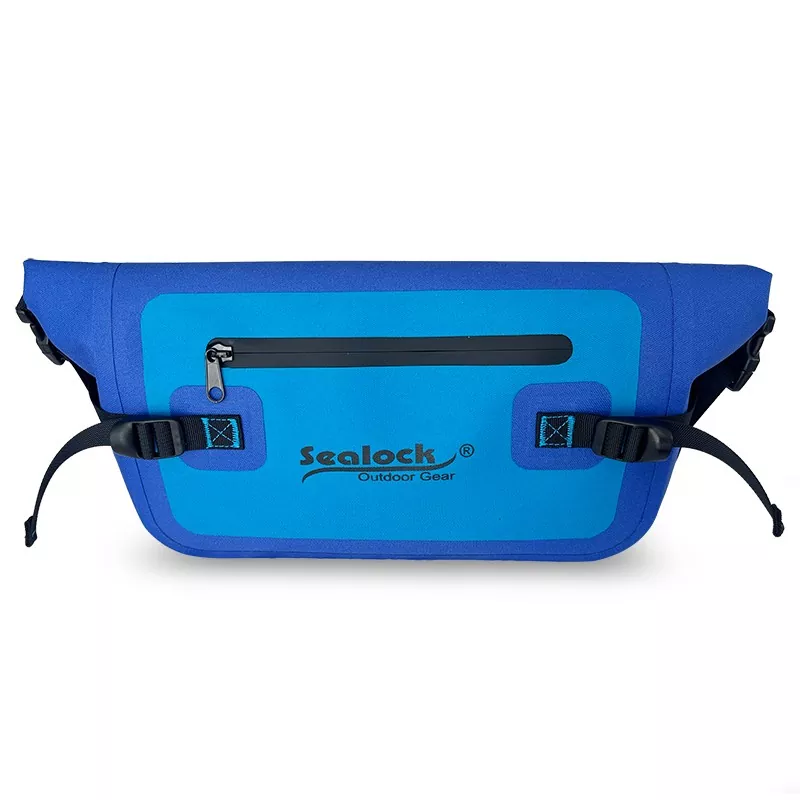
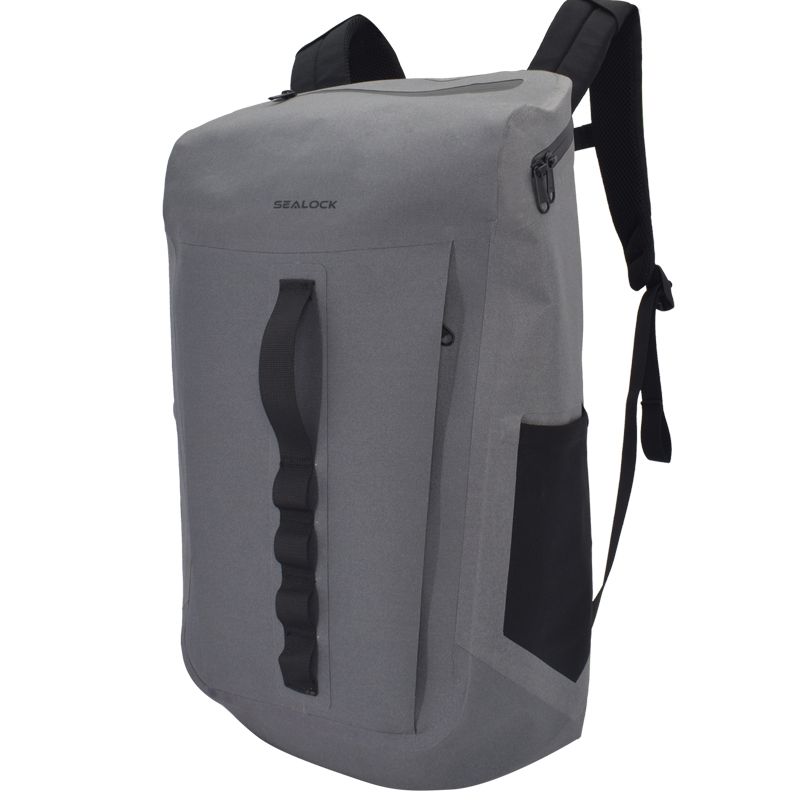
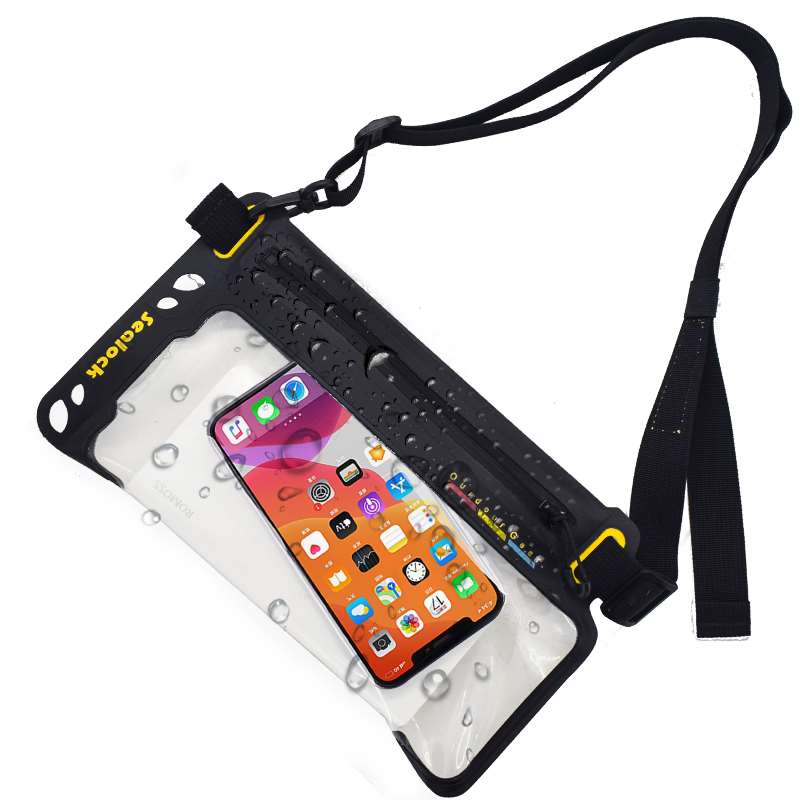
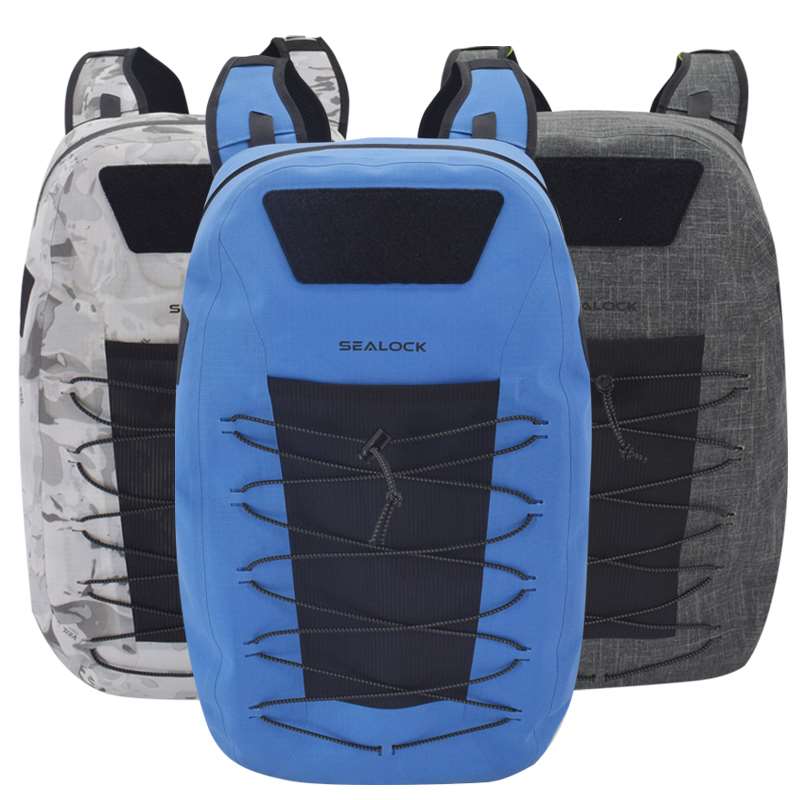
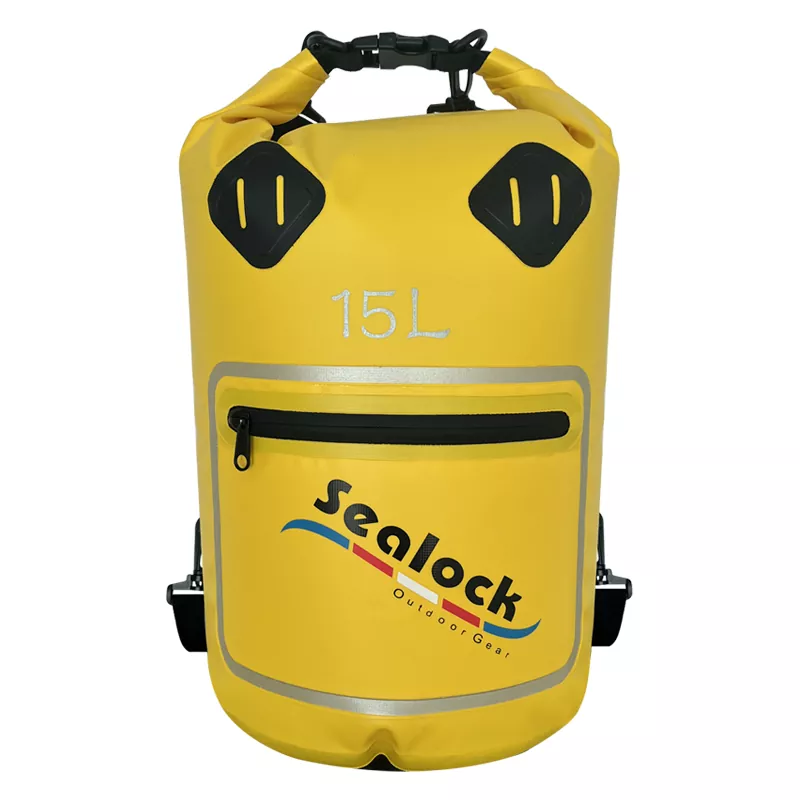
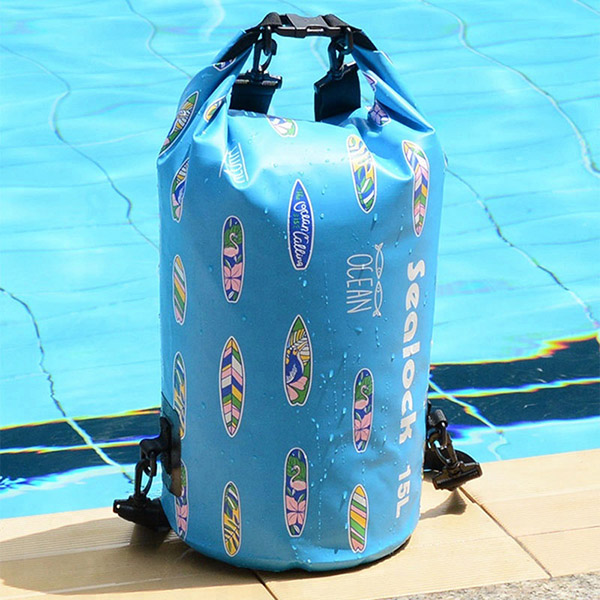
These welded bags, from Sealock's dry bag line, are equal starting points for an OEM order — none is ranked above another:
Core sizes with published dimensions and colour standards
500
Standard terms across the range: MOQ from 200 pieces depending on model, samples in 3–15 days, production 20–45 days after approval, FOB Shenzhen or Guangdong, with production available from Dongguan or Vietnam.
Evidence beats assurance — inspection records are available on every shipment.
FAQ: Choosing a Dry Bag Supplier
Q: How do I tell a real factory from a trading company?
A: Ask process questions. A factory names its welding equipment and frequency, states line count and monthly capacity, shows the production floor, and provides close-ups of welded seams and attachment points. A trading office can't go deep, and the gap usually shows within one email exchange.
Q: Is a trading company always the wrong choice?
A: Not always — one with strong factory control, clear specifications and reliable inspection can work. But for custom OEM dry bags, direct factory capability is easier to verify, particularly on welding, sampling and troubleshooting when something goes wrong mid-run.
Q: What's the most important technical question to ask?
A: Whether welding is done in-house and how weld consistency is verified across runs and shifts. The weld is the entire product, and a supplier that outsources it cannot guarantee batch-to-batch consistency.
Q: How should I evaluate a supplier's certificates?
A: Check the date, company name, certificate holder, issuing body, product category and report number, and confirm the certificate applies to your product. Missing signatures, calibration stamps or lab contact details are warning signs.
Q: Should I choose on unit price?
A: Not alone. Evaluate material knowledge, welding quality, sampling process, lead time control, QC system and communication. A price far below market usually means thinner material, sewn seams, or costs that reappear later as returns.
Q: What should I have in writing before paying a deposit?
A: A full price breakdown, material specification with tolerances, sample standard, timeline, MOQ, packaging, QC process, certificate status, payment terms, inspection options and after-sales responsibility — plus a signed gold sample.
Talk to the Factory
To evaluate Sealock against the checks above — including a factory walkthrough, weld close-ups, inspection records, and samples — contact us at info@sealock.com.hk or +86-769-82009361. Over twenty years of in-house high-frequency welding, nine welding lines, dual China–Vietnam production, third-party inspection on request, and a full customer inspection procedure on every shipment.
Používáme cookies, abychom vám nabídli lepší zážitek z prohlížení, analyzovali návštěvnost webu a přizpůsobili obsah. Používáním tohoto webu souhlasíte s naším používáním souborů cookie.
Zásady ochrany osobních údajů
 English
  Español
  Português
  русский
  Français
  日本語
日本語  Deutsch
  tiếng Việt
  Italiano
  Nederlands
  ภาษาไทย
  Polski
  Svenska
  magyar
  Malay
Malay  বাংলা ভাষার
  Dansk
Dansk  Suomi
Suomi  हिन्दी
  Pilipino
  한국어
한국어  Türkçe
  Gaeilge
  العربية
  Indonesia
  Norsk
Norsk  تمل
تمل  český
český  ελληνικά
  український
  Javanese
  فارسی
فارسی  தமிழ்
தமிழ்  తెలుగు
  नेपाली
  Burmese
  български
  ລາວ
ລາວ  Latine
  Қазақша
  Euskal
  Azərbaycan
  Slovenský jazyk
  Македонски
  Lietuvos
  Eesti Keel
  Română
  Slovenski
  मराठी
मराठी  Srpski језик